
Germany
The Freelancer Route
The Ultimate Guide to the Digital Nomad Visa (The Freelancer Route)
Germany, with its stunning cities, robust economy, and central European location, is an increasingly popular destination for digital nomads. While the country doesn't have an official "Digital Nomad Visa," it offers a well-established and highly sought-after path for remote workers and freelancers: the Residence Permit for Self-Employment for Freelancers ($Aufenthaltserlaubnis zur Ausübung einer selbständigen Tätigkeit - Freiberufler$), often simply called the German Freelancer Visa.
This is your comprehensive guide to understanding and successfully applying for this game-changing visa.
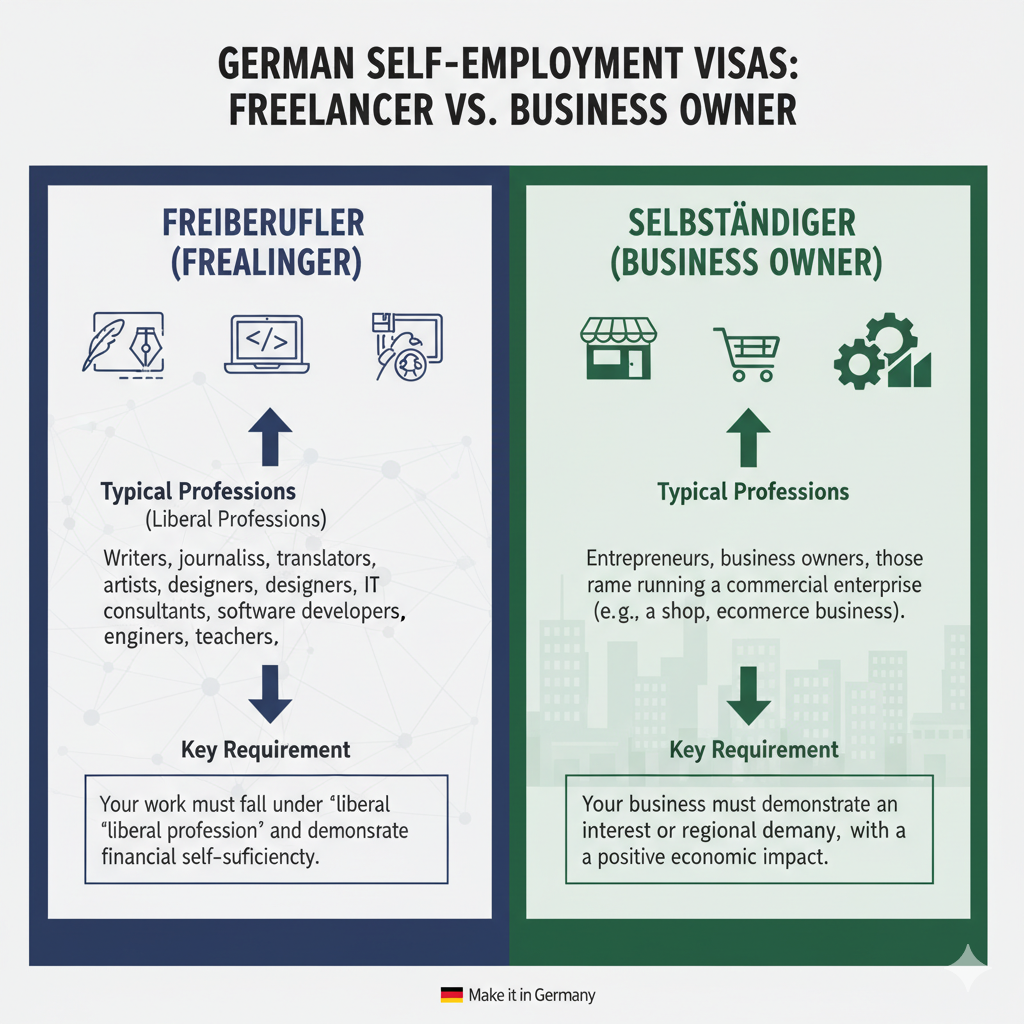
Understanding Your Visa: Freiberufler vs. Selbständige
Germany distinguishes between two main types of self-employment visas, and for most digital nomads, the Freiberufler (Freelancer) route is the correct one.
The Digital Nomad Sweet Spot: If your work is based on specialized, intellectual, or artistic skills (which most remote work is), you are likely a Freiberufler. This category has less stringent requirements regarding minimum investment and contribution to the German economy than the $Selbständiger$ (Self-Employed/Business) visa.
The Application Procedure: Step-by-Step
The application process is thorough and requires meticulous document preparation. It typically involves two phases: the Entry Visa and the Residence Permit.
Applying for the National (D-Type) Visa (Non-EU Citizens)
If you are a non-EU/EEA/Swiss citizen, you must generally apply for an entry visa (National Visa or D-Visa) at the German embassy or consulate in your home country before traveling.
Exception: Citizens of Australia, Canada, Israel, Japan, New Zealand, South Korea, the UK, and the USA can enter Germany without a visa and apply for the residence permit directly at the local Foreigners' Office ($Ausländerbehörde$ - see Phase 2).
Gather Documents: Prepare the comprehensive checklist (see below).
Book Appointment: Schedule an appointment for a National Visa application at your nearest German Embassy or Consulate.
Submit & Interview: Attend the appointment in person to submit your complete application, pay the fee (approx. €75), and attend a short interview.
Wait for Processing: Processing times can vary significantly (e.g., 4-12 weeks). Once approved, you receive a D-Visa sticker in your passport, valid for 3-6 months, allowing you to enter Germany.
Applying for the Residence Permit (After Arrival)
This is the final and crucial step, which determines your long-term right to live and work in Germany.
Register Your Address ($Anmeldung$): Within two weeks of arrival, you must register your address at the local Resident Registration Office ($Bürgeramt$). You will receive a Registration Certificate ($Meldebescheinigung$).
Register with the Tax Office ($Finanzamt$): Before applying for your residence permit, you may need to register as a freelancer ($Freiberufler$) with the local Tax Office to obtain your Tax Number ($Steuernummer$). You will need this for client invoices and often for the residence permit application.
Book Appointment at the $Ausländerbehörde$: Schedule an appointment with the local Foreigners' Office ($Ausländerbehörde$ / $Ausländeramt$) in your city (e.g., the $Landesamt für Einwanderung$ - LEA - in Berlin). Book this early, as appointments are often scarce.
Submit Final Application: Attend the appointment to submit your documents, biometrics, and pay the residence permit fee (approx. €100-€140).
Receive Permit: If approved, you will be issued your electronic residence card ($eAT$), typically valid for 1-3 years, with the option for extension if your freelance activity is successful.
The Essential Document Checklist
Always check the website of your specific German Embassy/Consulate or local Foreigners' Office for the exact, most up-to-date requirements, as they can vary by location.
Document CategoryRequired DocumentsDetails & TipsPersonal & Forms
1. Application Form$Antrag auf Erteilung eines Aufenthaltstitels$. Fill out the online VIDEX form and print.
2. Valid PassportMust be valid for at least 6 months, plus a copy of the biodata page.
3. Biometric PhotosTwo current, biometric photos (35x45mm).
4. CV/ResumeDetailed, chronological, outlining your professional career and qualifications.Financial & Business
5. Proof of Funds/IncomeBank statements showing sufficient savings OR a detailed Earnings Preview ($Ertragsvorschau$) projecting monthly income and expenses. The expected amount is typically €10,000 - €12,000 per year or proof of a viable income stream.
6. Letters of Intent/ContractsCrucial. At least two signed letters or contracts from clients (ideally German clients, but international can be accepted) detailing the scope, hours, and rates of the work.
7. Portfolio/QualificationsProof of your professional qualifications (e.g., degrees, diplomas, professional licenses, work samples) relevant to your freelance activity.
8. Tax RegistrationProof of registration with the $Finanzamt$ (Tax Office) if you applied while in Germany, or an application pending.Logistics & Insurance
9. Health InsuranceProof of valid German public or private health insurance. For the initial entry visa, travel insurance is often required, but for the residence permit, you need a full German-compliant policy.
10. Proof of AccommodationRental contract ($Mietvertrag$) or confirmation of occupancy from your landlord ($Wohnungsgeberbestätigung$).
11. Pension Plan (If over 45)Proof of adequate private retirement provisions.TranslationsAll documents not in German or English must be accompanied by a certified German translation.
Official Government Links and Resources
Please use these links as a starting point, but always verify requirements with the specific office you are applying to.
ResourceDescriptionMake it in GermanyThe official German government portal for qualified professionals immigrating to Germany. Excellent information on self-employment and visa types.Federal Office for Migration and Refugees (BAMF)Information on self-employment and freelancing residence permits.Federal Foreign Office (Auswärtiges Amt)General information on National Visas (D-Visas) and locating German missions abroad.Berlin Service Portal (Example $Ausländerbehörde$)An excellent, detailed example of the specific requirements for a freelance residence permit in a major city like Berlin (often the most popular choice for nomads).German Missions Abroad (Embassy Finder)Find your local German Embassy or Consulate to schedule the initial D-Visa appointment.
Key Takeaways for Success
Be Meticulous: Germans value precision. Submit a perfect, organized, and complete application.
Local Clients Help: While not mandatory to have only German clients, the German authorities want to see that your work is of benefit to the German economy, making a few German clients (or strong letters of intent) a significant advantage.
The Right Category: Be certain you qualify as a Freiberufler. If your work is too commercial (like running a store), you'll need the more complex $Selbständiger$ visa.
Patience is a Virtue: Processing times can be long, especially in popular cities. Start the process well in advance of your desired arrival date.
Good luck on your journey to becoming a legal Digital Nomad in the heart of Europe!